
EPC rating meaning: bands A to G
The EPC rating meaning comes down to one letter. That letter grades a home's energy efficiency, starting at A, the best, and ending at G, the worst.
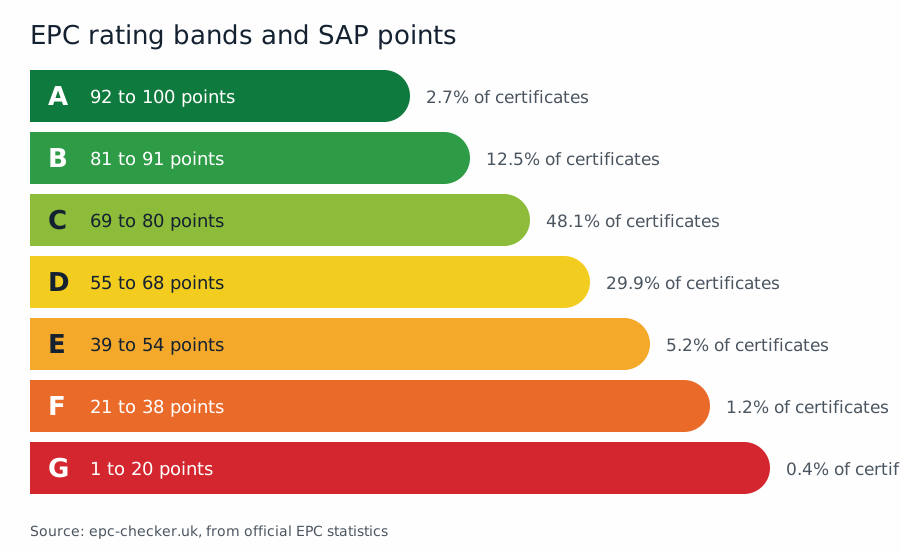
EPC rating bands A to G and their SAP points
- AScores of 92 to 100Found on 2.7% of certificates
- BScores of 81 to 91Found on 12.5% of certificates
- CScores of 69 to 80Found on 48.1% of certificates
- DScores of 55 to 68Found on 29.9% of certificates
- EScores of 39 to 54Found on 5.2% of certificates
- FScores of 21 to 38Found on 1.2% of certificates
- GScores of 1 to 20Found on 0.4% of certificates
How the EPC rating scale works
Think of the energy label on a fridge: the EPC rating A to G scale is very similar. The energy assessor comes to your home and notes the walls, the insulation and the heating.
A SAP score comes out of those details. The Standard Assessment Procedure, or SAP, is the government's method for scoring the energy a home uses, and scores usually sit between 1 and 100.
From that score, the letter follows. The higher your SAP rating, the more efficient the home, so 69 is the lowest score that still falls in band C.
This rating measures the building itself, not whoever lives there. Standard occupancy is what the government guide to EPCs says it assumes, so the bills you pay can differ.
EPC rating meaning for buyers and tenants
Before a viewing, the letter gives a buyer or tenant a fast way to compare homes. A better rating usually means lower fuel bills, according to the guide.
Before marketing a home, sellers and landlords must get an EPC, which stays valid for 10 years. Any certificate is there for you to look up on the official register of EPCs.
Use our EPC expiry tool to find out when your own certificate runs out.
What is a good EPC rating?
The middle of the scale is where most homes fall. Over the 10 years to March 2025, England's median was 69 and Wales's was 68. The EPC median means the middle score.
So the usual English home sits in band C's bottom spot, and the usual Welsh home in D's top. A C or above therefore beats the typical result.
Flats and maisonettes topped the rankings by type, at a median of 74. Newer properties, those from after 2012, went higher still, at 84.
Recent certificates tilt towards C. Band C accounted for 48.1% of domestic EPCs lodged during 2025, and band D for 29.9%.
Each EPC rating explained in one line
- A: the top letter for efficiency, and you'll rarely see one.
- B: where most new build homes end up.
- C: the goal for private rented homes, set for 2030.
- D: the most common letter across all EPCs going back to 2008.
- E: the lowest letter for letting today, though a landlord can go lower with an exemption.
- F: a landlord can't let at this level, so the home needs work, or an exemption must be registered.
- G: the weakest band of all, and letting it out is banned just as with F.
Your current and EPC potential rating
Two letters appear on an EPC. The first letter is the current one. The second is the potential rating. It assumes you follow all the cost-effective recommendations listed on the certificate.
Every recommendation shows a rough cost, what you'd typically save and the rating you get once the work is done. There's no legal duty to do any of them, so you can skip them if you want.
For landlords, these steps count for more. A typical cost for reaching band C comes from our estimator for improvement costs.
The letter's meaning when you let a home
A landlord in England or Wales needs a valid exemption before letting any covered home that rates below E. Since 1 April 2020, that rule has covered every let that falls under it.
Stricter requirements are coming. The government response targets EPC C for every private tenancy by 1 October 2030. Spending per property is capped at £10,000.
Until its EPC expires, a home scoring C or above before 1 October 2029 counts as meeting the new standard. See how your own let does with our 2030 check for landlords.
New style EPCs will also use a new method to score homes. Our guide to EPC reform covers what is changing.
EPC ratings: common questions
Which EPC rating is the lowest one you can rent out?
The answer is band E, for England and Wales. Letting a covered home with an F or G rating isn't allowed without a registered exemption, the guidance for landlords explains.
Is a D bad on the EPC scale?
No, D sits near the middle. The top of band D is 68, and that was the median score in Wales, according to the ONS. Under the planned rules, landlords will need a C by 2030.
Does a better EPC rating bring lower bills?
In most cases, yes. According to the government guide, a better rating usually means lower fuel bills.
How long does an EPC last?
Each EPC lasts 10 years. After that, you'll need a new one before selling or letting the home.
Is it possible to improve my EPC rating?
Yes. Your certificate sets out the work it recommends and the rating you'd get after each job. When the work is finished, a new assessment records your new letter.